Learn How to Use a Moss Pole for Monstera and Why
Monstera plant has a climbing ability so it is a climbing plant. In forest or other wild place it can grow upward and use its Aerial roots for climbing on trees where it can get fresh air and sunlight while indoor it need a support like moss pole for climbing. This climbing process of monstera can increase its growth speed. A moss pole is not required for every Monstera some types need while other not. A young plant can grow without any support and some growers prefer a simple stake. A climbing support becomes useful when the stem starts spreading across the pot or support heavy large leaves.The right support can also make an indoor Monstera easier to manage. It gives the main stem a clear direction, helps keep the plant upright, and gives aerial roots a surface to contact.
What a Moss Pole is
A plant support covered or filled with moss and placed vertically with plant. Sphagnum moss is most famous and commonly used because it can retain moisture.
The support or pole is placed inside pot behind the main stem. The Monstera stem is then attached to the pole with soft plant ties.
When the plant grows its aerial roots may reach the moist moss and attach to it. Monstera uses tree trunks for support in its native forest habitat. The University of Wisconsin Madison recommends a strong, moss covered support for Monstera so it can climb easily and aerial roots can attach to it.
Monstera's Climbing Growth
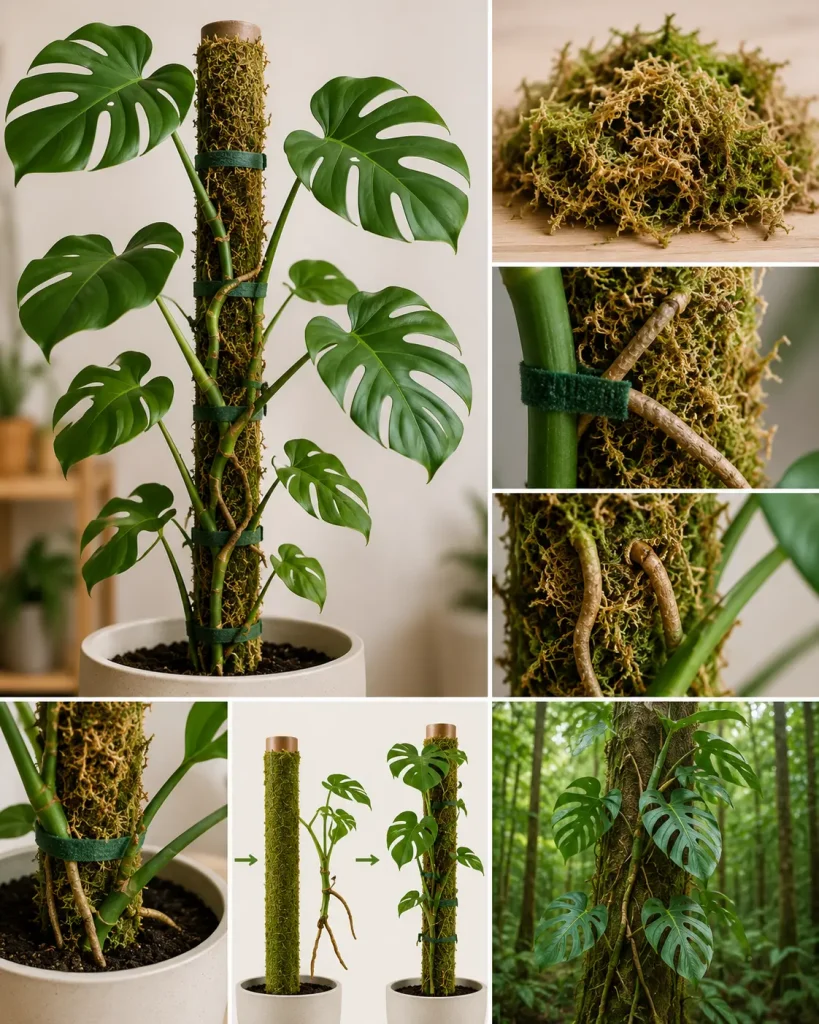
Monstera deliciosa is a climbing plant. In forests as we know it can climb on tree’s trunks and grow toward higher parts for fulfilling it’s needs.
The aerial roots produced from its stem help it for climbing. These roots can attach to nearby surfaces and when they reach suitable conditions then can also grow into the ground.
This climbing habit explains why a vertical support works better indoor. Instead of allowing a long stem to spread across a shelf or floor. The support help the plant to move above from the floor. Penn State Extension also notes that moss sticks, trellises, bamboo stakes and moss covered boards can be used to support Monstera indoors they work same like a moss pole.
Monstera Benefits From a Moss Pole
Better Stem Support
When the monstera start becoming big it can also produce new leaves and the stem become little weak due to leaves weight so by add a support the weight of leaves can be shifted to it and stem feel free.
A Place for Aerial Roots
Aerial roots are a part of Monstera growth. Some people think they are a sign of poor growth but not.When these roots reach a damp, textured moss surface, they may attach to it. This gives the plant another way to anchor itself as it grows.
More Upright Growth
Without support, a Monstera may spread sideways but it cannot be move upward and can be spread on the floor so by adding a support can helps in increasing the height and growth of a plant.
Support for Mature Growth
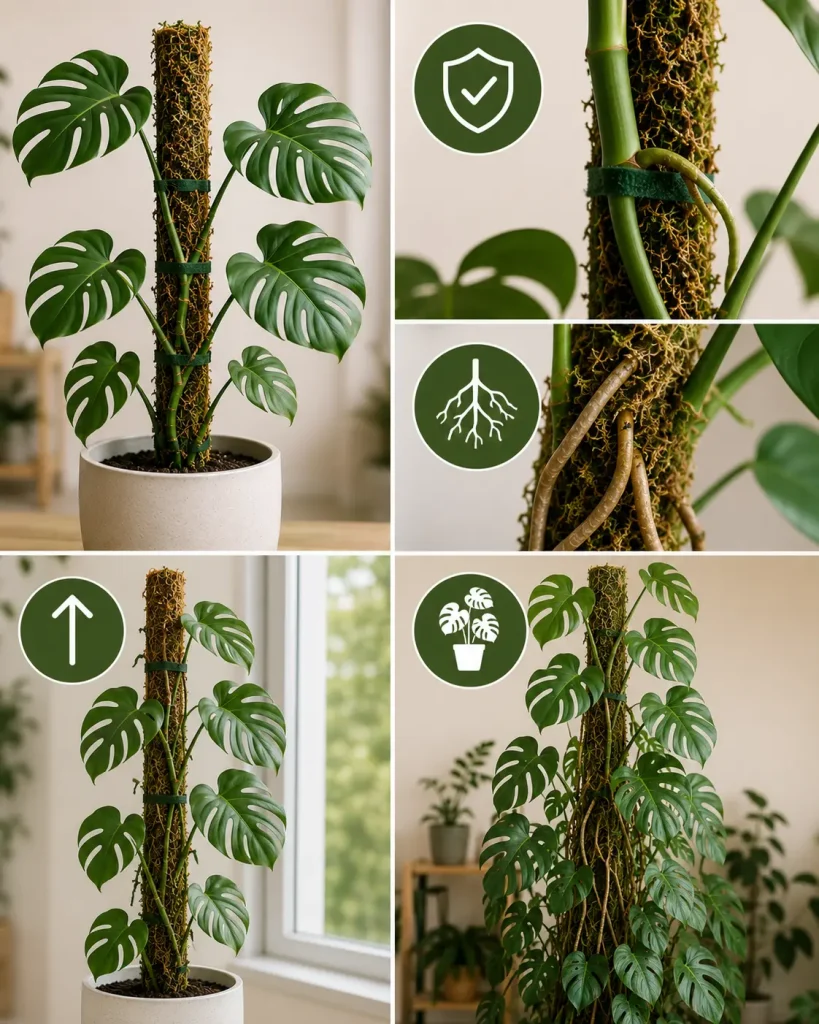
Leaf size and splits depend on several factors, including plant age, genetics, light, root health, water and nutrition. A moss pole does not create large leaves by itself but it can support the stem in holding the weight of leaves.
Good growing conditions are still needed. The pole mainly gives the plant a suitable structure for climbing easily.
When to Add a Moss Pole
There is no fix age and time at which every Monstera needs a pole.
A support becomes useful when you notice:
* The main stem leaning to one side
* Long growth hanging over the pot
* Aerial roots growing from the stem
* The plant becoming difficult to keep upright
* Leaves becoming heavy for the stem
* New growth needing a clear upward direction
A small size Monstera can stay without any support.
Choosing the Right Moss Pole
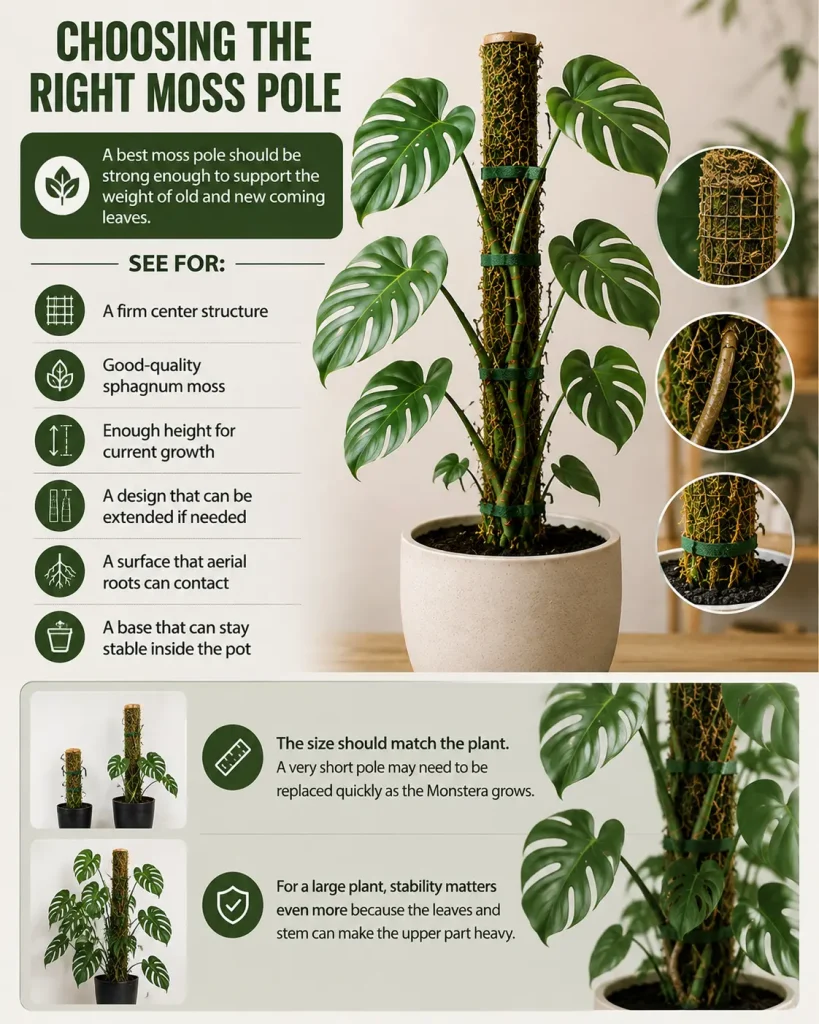
A best moss pole should be strong enough to support the weight of old and new coming leaves.
See for:
* A firm center structure
* Good-quality sphagnum moss
* Enough height for current growth
* A design that can be extended if needed
* A surface that aerial roots can contact
* A base that can stay stable inside the pot
The size should match the plant. A very short pole may need to be replaced quickly as the Monstera grows.
For a large plant, stability matters even more because the leaves and stem can make the upper part heavy.
Moss Pole Materials
Sphagnum Moss
Sphagnum moss is one of best and common choice but it is not the only option. Sphagnum can retain moisture and gives aerial roots a textured surface Its main drawback is that it needs regular attention. If it becomes completely dry, it can become harder to wet again.
Coco Coir
Coco coir provides a textured surface and can give the stem good physical support. It usually holds less moisture than sphagnum moss.
Wooden Support
A wooden board or untreated branch can provide a surface for climbing. Penn State Extension lists boards and other supports among the options suitable for Monstera.
Bamboo or Plain Stake
A bamboo stake can keep the stem upright, but it does not provide the same moisture-holding surface as a moss pole.
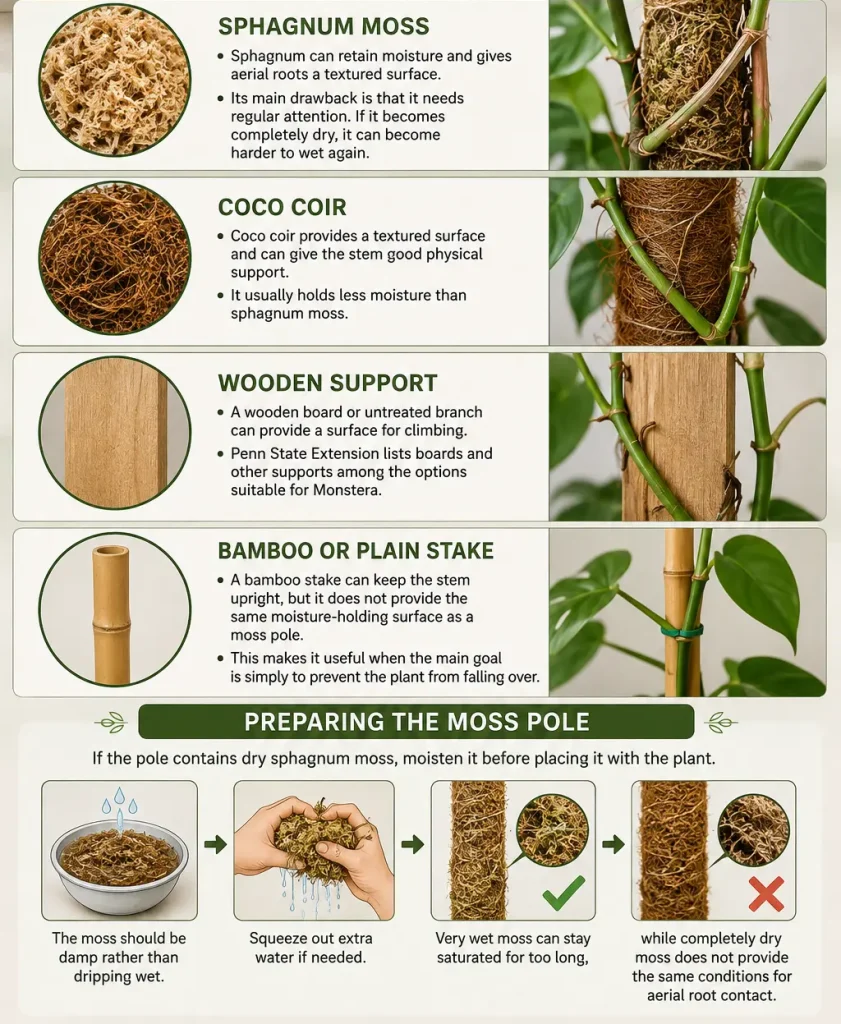
This makes it useful when the main goal is simply to prevent the plant from falling over.
Preparing the Moss Pole. If the pole contains dry sphagnum moss, moisten it before placing it with the plant. The moss should be damp rather than dripping wet. Squeeze out extra water if needed. Very wet moss can stay saturated for too long, while completely dry moss does not provide the same conditions for aerial root contact.
Placing the Moss Pole in the Pot
The pole should be placed close to the back of the Monstera’s main stem. Push the base firmly into the potting mix so it does not wobble. The pole needs enough support at the base to carry the plant as it becomes taller. A weak or loose pole can tip when the plant becomes large. If you are repotting, placing the pole before filling the pot with the final layer of soil can make it easier to keep the support stable.
Positioning the Monstera
Look at the main stem before attaching it. The side of the stem with the nodes and aerial roots should face the moss pole. This gives the roots a better chance to reach the support. Do not force the entire plant against the pole. The goal is to guide the stem, not bend it into an unnatural position.
Attaching the Main Stem
Use soft plant tape, Velcro plant ties, or another soft material. Attach the main stem, not the leaf stalks. The tie should be loose enough to leave room for the stem to become thicker. Tight ties can press into the stem and cause damage as the plant grows. Penn State Extension recommends gently attaching Monstera to its support using its roots or stalk. A recent 2026 plant-care guide also recommends soft, loose ties and leaving the leaf stalks free to move.
Training New Growth
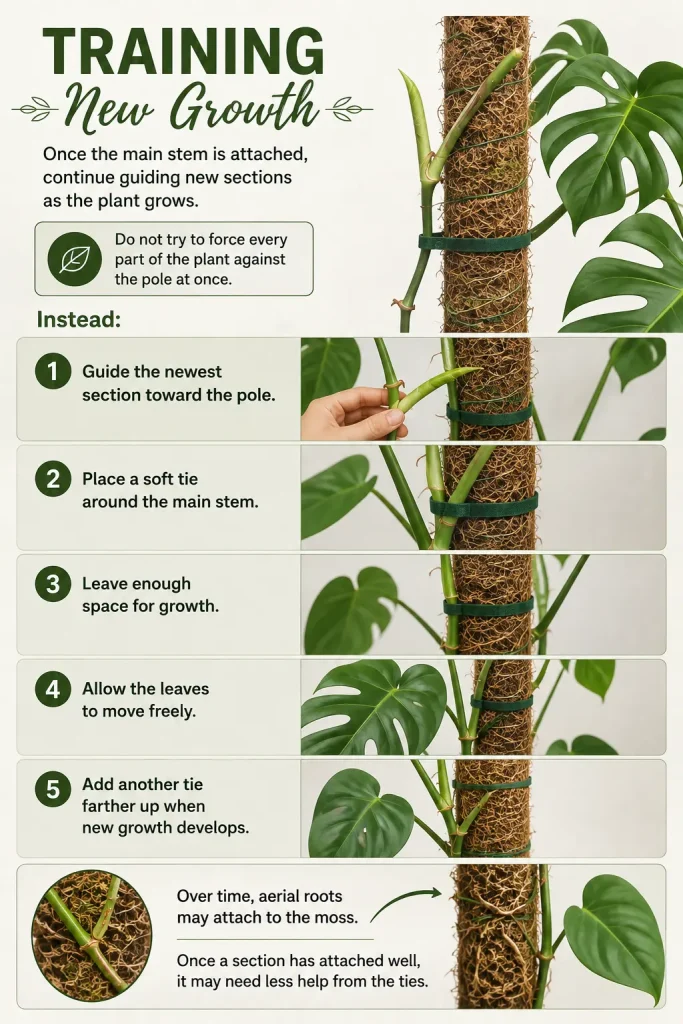
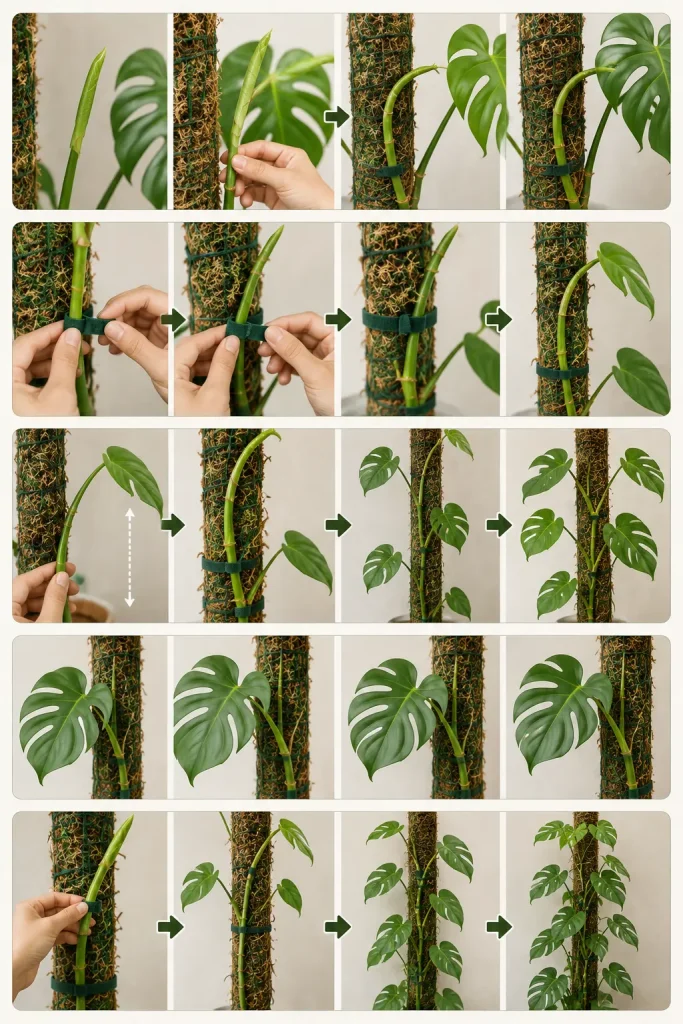
Once the main stem is attached, continue guiding new sections as the plant grows.
Do not try to force every part of the plant against the pole at once.
Instead:
1. Guide the newest section toward the pole.
2. Place a soft tie around the main stem.
3. Leave enough space for growth.
4. Allow the leaves to move freely.
5. Add another tie farther up when new growth develops.
Over time, aerial roots may attach to the moss. Once a section has attached well, it may need less help from the ties.
Caring for the Moss
The moss should stay lightly moist if you want aerial roots to contact a damp surface. You can add water from the top of the pole and allow it to move through the moss. Check it regularly rather than following a fixed daily schedule. The exact frequency depends on room temperature, humidity, airflow, pole material, and season. The soil and the moss pole should be treated as two separate areas. Do not keep adding water to the pot simply because the pole feels dry.
University of Wisconsin–Madison recommends watering the moss-covered support as well as the plant because aerial roots can obtain water and nutrients there. It also advises allowing the soil to dry slightly between waterings.
Caring for the Monstera After Adding the Pole
A moss pole does not replace normal Monstera care. The plant still needs suitable light, proper watering, good drainage, enough root space, and suitable temperatures. Bright light is especially useful for strong growth. Penn State Extension recommends bright light while protecting the plant from harsh direct sunlight. Keep checking the stem and ties as the plant grows. A tie that was loose several weeks ago can become tight later. Remove or adjust any tie that starts pressing into the stem.
Aerial Roots and the Moss Pole
Aerial roots can look unusual, especially when they become long. There is no need to cut them simply because they are visible. Some roots may reach the moss pole and attach. Others may grow away from it. Both situations can occur on a normal Monstera. If an aerial root is close to the pole, you can gently guide it toward the moss. Do not bend it sharply or force it into the moss. Aerial roots are part of the plant’s climbing system, so handling them gently is the safest approach.
Common Moss Pole Mistakes
| Mistake | Why It’s a Problem | What to Do Instead |
|---|---|---|
| Using Tight Ties | A tight tie can press into the growing stem and damage it as it expands. | Use soft plant ties and leave enough room for the stem to grow thicker. |
| Attaching the Leaf Stalks | Leaf stalks (petioles) need freedom to move toward available light. Tying them restricts natural growth. | Attach only the main stem, not the leaf stalks. |
| Using a Pole That Is Too Short | A fast-growing Monstera can quickly reach the top of a small pole, leaving no room to continue climbing. | Use a stackable or extendable moss pole to support future growth. |
| Keeping the Moss Completely Dry | Dry moss does not provide the moist surface aerial roots need to attach and grow. | Check the moss regularly and moisten it whenever it begins to dry out. |
| Keeping the Moss Constantly Soaked | Permanently saturated moss can stay too wet. More water is not always better. | Keep the moss damp, not dripping wet or continuously saturated. |
| Expecting the Pole to Create Large Leaves | A moss pole encourages climbing but does not automatically produce giant leaves. | Provide good light, proper watering, nutrition, healthy roots, and overall good plant care along with the pole. |
| Placing the Plant in Poor Light | A moss pole cannot compensate for insufficient light. Poor lighting limits healthy growth. | Place the plant in bright, indirect light for the best growth and leaf development. |
Moss Pole Care During Different Seasons
Spring and Summer
Monstera often grows more actively during warmer months. Check the pole more often because the moss may dry faster. Continue normal watering and feeding based on the plant’s growth and care needs.
Autumn
Growth begin to slow as light levels change. Check the moss before adding water.
Winter
Indoor air can become drier, especially when heating is used. At this time the growth of plant becomes slow Do not keep the soil wet simply because the air is dry. Check the soil and moss separately.
When a Moss Pole Is Not Needed
A moss pole is optional.
You may skip one if:
* Your Monstera is still very small.
* The plant is growing upright on its own.
* You prefer a trailing shape.
* You only need a simple stake for support.
* You do not want to maintain moist moss.
A Monstera live without a moss pole but the condition is that the other need of monstera must be fulfil.
The main benefit of the pole is that it gives a climbing plant a vertical surface that matches its growth habit and also give a support to stem.
Moss Pole Compared With Other Supports
| Support | Main Purpose | Moisture for Aerial Roots | Best Use |
|---|---|---|---|
| Sphagnum Moss Pole | Climbing & support | Yes | Mature climbing Monstera |
| Coco Coir Pole | Climbing & support | Some | Plants needing a textured surface |
| Bamboo Stake | Stem support | No | Young or leaning plants |
| Wooden Board | Climbing support | Usually no | Large climbing plants |
| Trellis | General plant support | No | Plants needing structure |
The best choice depends on what you want from the support. If you mainly want to stop the plant from falling, a simple stake may be enough. If you want to give aerial roots a moist surface for attachment, sphagnum moss offers an extra benefit.
Professional Advice
A moss pole help’s monstera plant in climbing by giving a place. Its moist textured surface can give aerial roots a good place to attach. For the best result place the pole in the pot, face the main stem toward it and use soft ties around the stem. Remember that the pole is a part of Monstera care. Good light, healthy roots, suitable watering, nutrition and enough space are also needed for strong growth.
Monstera naturally uses trees as climbing structures in forests. Giving an indoor plant a moss covered support lets it use part of that same climbing habit in your home.
FAQs
What plants need a moss pole?
Climbing plants benefit most from a moss pole. Good examples include Monstera deliciosa, Monstera adansonii, Rhaphidophora tetrasperma, climbing Philodendrons, Anthurium, and Scindapsus. These plants can use a vertical surface for support as their stems grow.
Trailing plants can also use a pole if you want them to grow upward. Plants that naturally stay compact usually do not require one.
How to make a self-watering moss pole?
A self-watering moss pole can be made with a PVC pipe, plastic mesh, sphagnum moss, a water reservoir, and a wick or internal water channel.
First, form the outer structure around the pipe and fill it with damp sphagnum moss. Add a wick or narrow tube that carries water from the lower reservoir toward the moss. Keep the water level low enough that the moss stays moist rather than soaked.Check the pole regularly. If the moss stays too wet, reduce the water supply. Good airflow is also helpful.
Can I mount my orchid on a moss pole?
Yes, some orchids can be mounted on a moss pole. Epiphytic orchids, such as Phalaenopsis and Dendrobium, can grow with their roots attached to a suitable support Use soft ties to secure the orchid without squeezing its roots or stem. Keep the roots slightly moist while allowing plenty of airflow. Avoid keeping the moss constantly wet because orchid roots can suffer when they remain waterlogged.
How do you take care of a Monstera plant?
Monstera care mainly involves light, water, soil, temperature, humidity, feeding, and support.
- Light: Give it bright, indirect light. Strong direct afternoon sun can scorch the leaves.
- Water: Water when the upper part of the soil has started to dry. Avoid leaving the pot sitting in water.
- Soil: Use a loose, well-draining mix that allows air to reach the roots.
- Temperature: Keep the plant in a warm indoor area away from cold drafts.
- Humidity: Moderate to high humidity can support healthy leaf growth.
- Fertilizer: Feed during active growth according to the fertilizer label.
- Support: A moss pole or other sturdy support can help climbing Monsteras grow upright.
- Pruning: Remove damaged or dead leaves with clean scissors.
- Repotting: Move the plant to a larger pot when the roots have filled much of the existing pot.
Good light and proper watering are especially important. A moss pole can support climbing, but it does not replace basic plant care.