How to Propagate Monstera Plant
A Monstera plant is popular indoor plants because of its large leaves and easy care. People who like planting monstera a big level but cannot afford to buy them they don’t need to worry they just have to learn a propagation technique. Through this technique they made a lot of monstera plants by one monstera plant.Learning how to propagate a Monstera plant is easy for everyone. You just have to know where to make the cut and give the cutting the right care, it can grow healthy roots and become a new plant. The biggest reason people fail is thinking that propagation is hard. It is because they cut the wrong part of the plant.
Quick Answer
Best way for a propagation of a Monstera plant is by taking a healthy stem cutting having a one or more node on it. Know you have to place the node in clean water, moist potting mix or damp sphagnum moss. Keep cutting in indirect light and warm conditions and don’t place it in direct light. Most cuttings begin growing roots within two to four weeks but new leaves usually take longer to appear and reach their proper size. A cutting without a node cannot grow into a new plant so you have to take a stem having a node.
What Does It Mean to Propagate a Monstera Plant?
It means growing a new plant without a seed. For Monstera plants you can do propagation by taking a healthy stem cutting having at least one node. When the cutting grows roots it can be planted in soil where it continues growing as a new plant and express a lovely view.
This technique is most popular because it is simple, costs almost nothing and produces a plant that has the same features as the parent plant.
Many indoor gardeners use propagation to:
* Grow more plants without buying them
* Replace an older plant
* Share plants with family and friends
* Save healthy stems after pruning
* Fill empty pots with new growth
Can Every Monstera Plant Be Propagated?
Most healthy Monstera plants can be propagated. The process works best on mature plants because they usually have thicker stems and several nodes.
Some young plants not have enough stem to take a best safe cutting. If a Monstera has few leaves it is better to let it grow larger before removing any stems.
A healthy parent plant should have:
* Firm green stems
* Healthy leaves
* No signs of pests
* No stem rot
* Active growth
A weak or unhealthy plant may struggle after taking cuttings.
The Most Important Part of Propagation: The Node
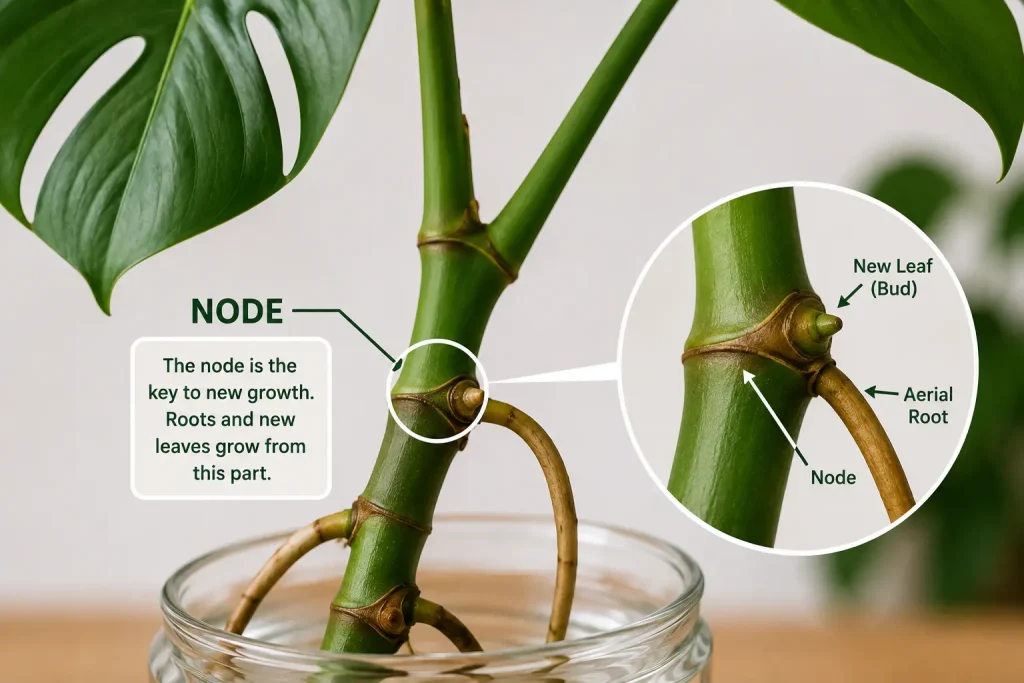
Before cutting a stem from monstera plant you have to find a node on that stem because it is a growing point.
Node is the place on the stem where new roots and new stems grow. It looks like a small raised bump. Many nodes have an aerial root growing from them it is good because a node having an aerial root can grow faster. Without a node the cutting cannot become a new plant it is useless .
Many beginners think that leave can also grow roots but its not possible. A leaf may stay green for weeks or even months but it cannot grow into a complete Monstera because it has no growing point like a node. Always check for a node before cutting a stem.
What is an Aerial Root?
Aerial roots are those roots that grow from the stem and move above the soil they don’t remain under the soil. In nature, Monstera plants use these roots to climb trees and at indoor they need a support for climbing. An aerial root are helpful during propagation because it can grow into regular roots after being placed in water or soil. But an aerial root alone is not enough. Your cutting still needs a node.
Best Time to Propagate a Monstera Plant
You can propagate Monstera all the year but the results are best and faster during growing season.
The best months are:
* Spring
* Early summer
Mean while these months the plant naturally produces more growth. Warm temperatures and longer daylight help roots to form quickly.
Propagation during winter is still possible, but due to less amount of required sunlight the rooting may takes longer because plant growth slows down.
Things You Will Need
Before taking a cutting, gather everything first.
You will need:
* Healthy Monstera plant
* A clean knife
* A clean glass or jar
* Fresh water
* A small nursery pot
* Well-draining potting mix
* Sphagnum moss if using the moss method
* Gloves if you have sensitive skin
Clean tools prevent the chance of spreading disease. If your scissors are dirty wipe the blades with rubbing alcohol before making any cuts because dirty scissors can cause problem if not clean.
How to Choose the Best Stem
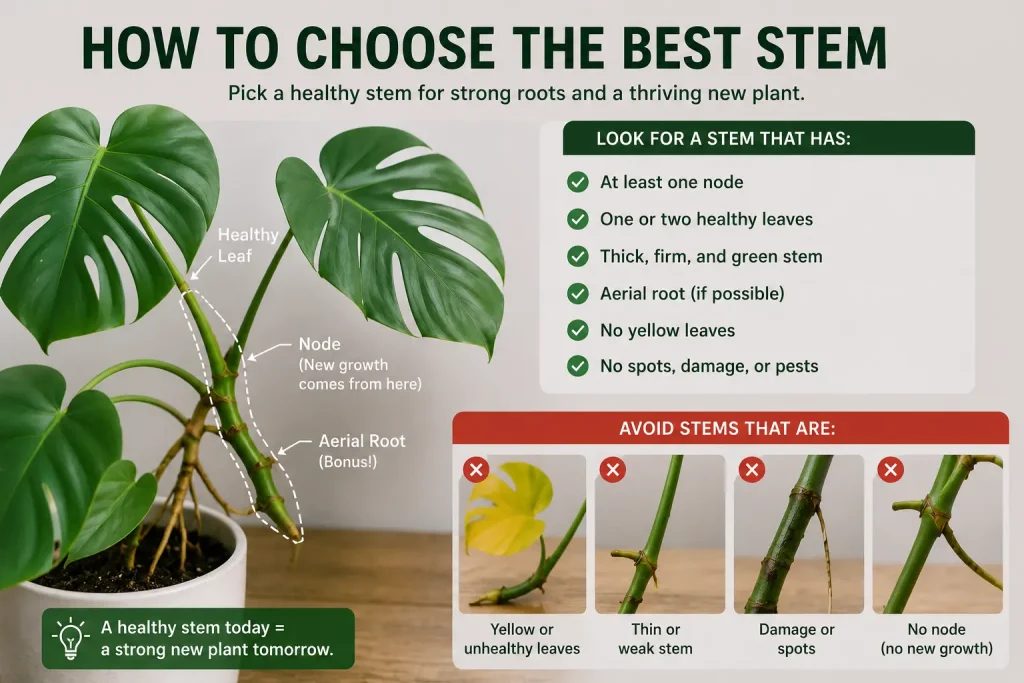
Not every stem makes a good cutting.
Look for one that has:
* At least one healthy node
* One or two healthy leaves
* Thick green stem
* No yellow leaves
* No soft or black spots
* No pests
Avoid stems that are damaged.
Healthy or strong cuttings can root faster.
How to take a Monstera cutting
You have to find the right stem ant then follow these steps.
Step 1
Find the node.
Step 2
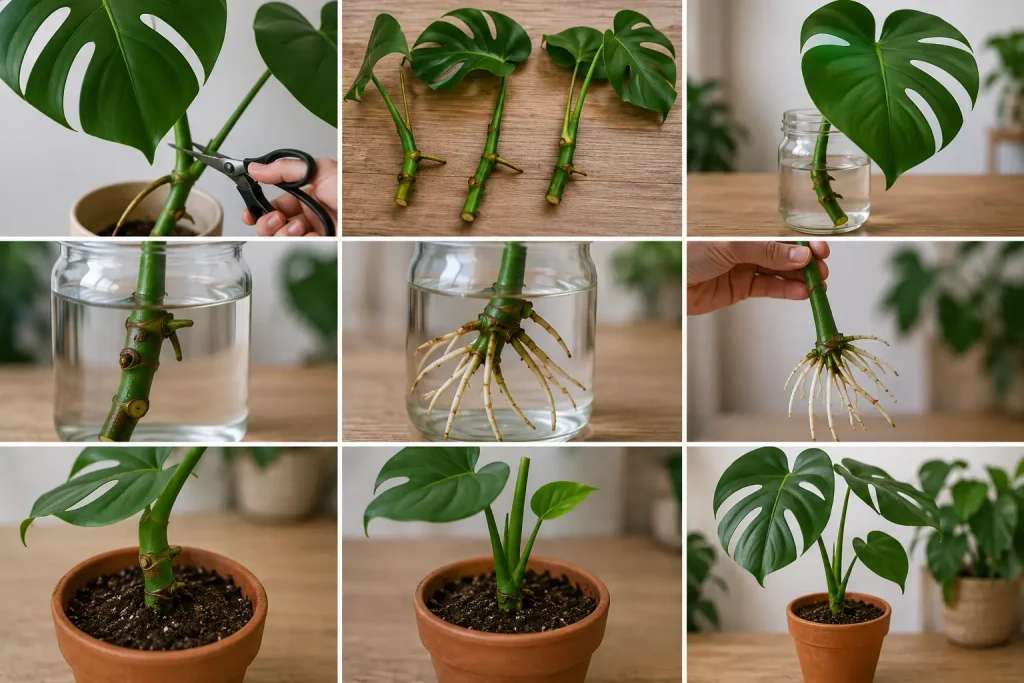
Place scissors about one inch below the node and beware of cutting at node point.
Step 3
Make one clean cut.
Do not crush the stem.
Step 4
During preparing it for propagation protect the cutting from direct sunlight.
Method 1: Propagating Monstera in water
Water propagation is the easiest methods for beginners because you can watch the roots growing under water.
Step 1
Fill a clean glass with room temperature water.
Don’t use very hot or very cold water.
Step 2
Place the node under the water.
The leaves should be above the water line.
Step 3
Put the glass near a window where indirect sunlight reaches easily.
Direct afternoon sunlight can damage the cutting and stop growing.
Step 4
Replace water after a week.
Fresh water helps keep bacteria low and gives the cutting enough oxygen and food.
Step 5
Wait for roots to appear.
Small white roots usually begin growing within two to four weeks.
Once several roots reach about two to three inches long, the cutting is know ready for soil.
Method 2: Propagating Monstera in Soil
Some people prefer and like planting the cutting directly into soil.
This removes the need to move roots from water to soil later.
Fill a small pot with well draining and soft soiol.
Make a small hole.
Place the node in the soil.
Keep the leaves above the soil.
Water less until the soil becomes some moist.
Keep pot in indirect sunlight.
Do not allow the soil to stay wet for more time.
Method 3: Propagating Monstera in Sphagnum Moss
Sphagnum moss keeps node moist and also allows air to reach the roots and this way of propagation is best after water technique. Many plant growers like this way because roots often adjust well after moving into soil.
Wet the moss.
Remove out extra water.
Place the cutting so the node touches the damp moss.
Keep the moss lightly moist.
Which Propagation Method Is Best?
Every method works correctly if it is done properly. While water propagation is usually the easiest for beginners because root growth is easy to watch. Soil propagation saves time and one extra step because the cutting is already growing where it will have to stay. Sphagnum moss gives good air flow around the roots and often produces healthy root systems. The best choice depends on what you already have at home.
How Long Does Propagation Take?
Every cutting grows at its own speed. Many healthy cuttings follow a similar timeline.
| Growth Stage | Average Time |
|---|---|
| 🌱 First roots appear | 2–4 weeks |
| 🌿 Several healthy roots develop | 4–6 weeks |
| 🪴 Ready to plant in soil | Around 6 weeks |
| 🍃 First new leaf appears | 2–3 months |
When Should You Move Water Roots Into Soil?
Be slow and do not do in rush this step.
Wait until:
* Several roots have formed
* Roots are about two to three inches long
* Roots look white and healthy
After planting, water the soil. Keep the plant in indirect light for some first few weeks. Caring for a Newly Propagated Monstera The first few weeks are important. Your young plant needs steady care while building a stronger root system so you also have to notice the changes.
| Water | Light | Temperature | Humidity |
|---|---|---|---|
|
• Keep the soil slightly moist. • Do not let the soil stay dry for long periods. • Avoid overwatering because it can cause root rot. |
• Bright indirect light helps the plant grow well. • Strong direct sunlight can burn young leaves. • Very dark rooms slow growth. |
• Best between 65°F–85°F (18°C–29°C). • Keep away from cold drafts because they slow root growth. |
• Higher humidity helps young roots grow better. • If the air is very dry, place the pot near other plants to increase humidity. |
Should You Use Fertilizer?
A fresh cutting does not need fertilizer instantly. When the plant start producing new leaves know it’s time for a fertilizers. Know you have to use a balanced houseplant fertilizer at half strength during the growing season. Applying fertilizer too early may damage young roots and cause other problems.
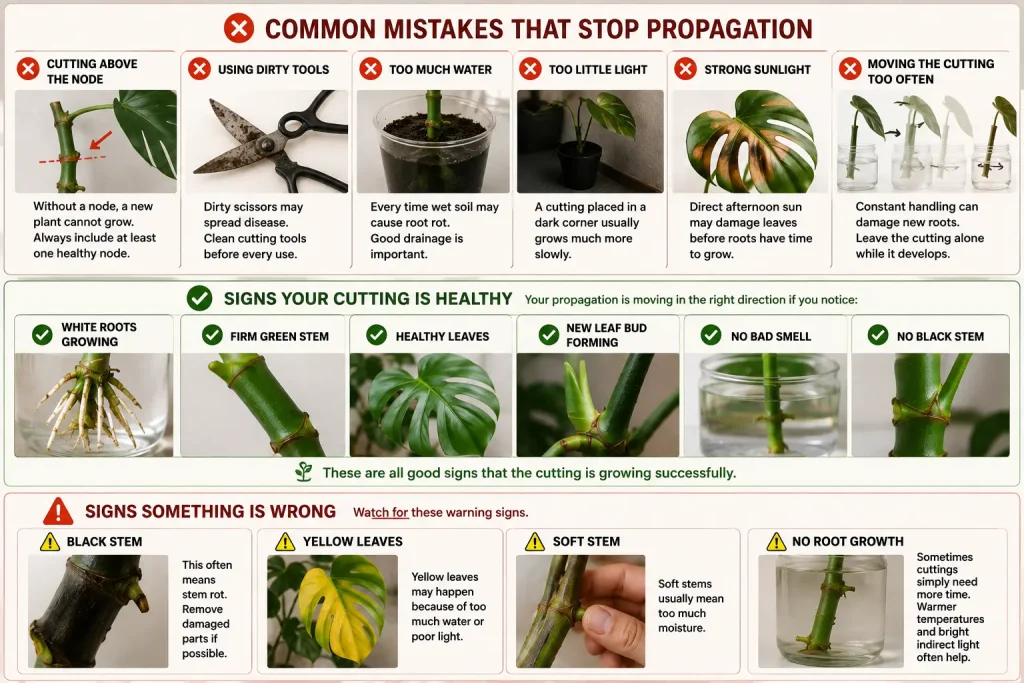
Common Mistakes That Stop Propagation
Can You Propagate a Single Monstera Leaf?
No. A leaf without a node cannot become a complete plant. Although the leaf may stay alive for a while, it has no growing point for new stems. Always include a node.
Final Thoughts
Learning propagation of monstera plant can helps you a lot in making a large amount of plants from one plant. Learning tells you which stem you have to choose for propagation and what are the other needs to for propagation of a monster plant. This technique helps you to know more about the monstera plant.
FAQs
Can I propagate a Monstera plant without a node?
No. A Monstera cutting must have at least one healthy node to grow into a new plant. A leaf without a node may stay green for some time, but it will not produce roots, stems, or new leaves.
What is the fastest way to propagate a Monstera plant?
Water propagation is often the easiest and fastest method for beginners because you can watch the roots grow. Under the right conditions, healthy cuttings usually start developing roots within 2 to 4 weeks.
How long does it take for a Monstera cutting to grow new leaves?
Most Monstera cuttings begin growing roots within 2 to 4 weeks. A new leaf usually appears after 2 to 3 months, depending on light, temperature, humidity, and the health of the cutting.
Should I propagate Monstera in water or soil?
Both methods work well. Water propagation lets you see root growth, while soil propagation allows the roots to grow directly in their final growing medium. Choose the method that works best for your setup and experience.
When should I move a Monstera cutting from water to soil?
Move the cutting when it has several healthy white roots that are about 2 to 3 inches (5 to 7.5 cm) long. This gives the new plant a better chance to settle into the soil and continue growing.