Why Does My Monstera Have No Splits?
Monstera plants are loved for their large green leaves with natural holes and splits. These leaves give the plant its well-known Swiss cheese appearance. However, not every Monstera grows leaves with openings. Some indoor plants produce small, heart shaped leaves that remain solid even after several months of care. If you are asking, why does my Monstera have no splits, there may be several reasons. Your plant might still be young, receive too little light, or lack a suitable climbing structure. Watering problems and poor root health can also slow its growth. The good news is that solid leaves do not always mean something is wrong. Young Monstera plants naturally produce leaves without holes. As they grow, their newer leaves may become larger and start developing openings.
What Are Monstera Fenestrations?
Fenestrations are the natural holes and splits that form in Monstera leaves. The word refers to window-like openings in the leaf surface. These openings are a common feature of mature Monstera deliciosa. Some leaves have small holes near the center, while others develop long cuts that begin at the outer edges.
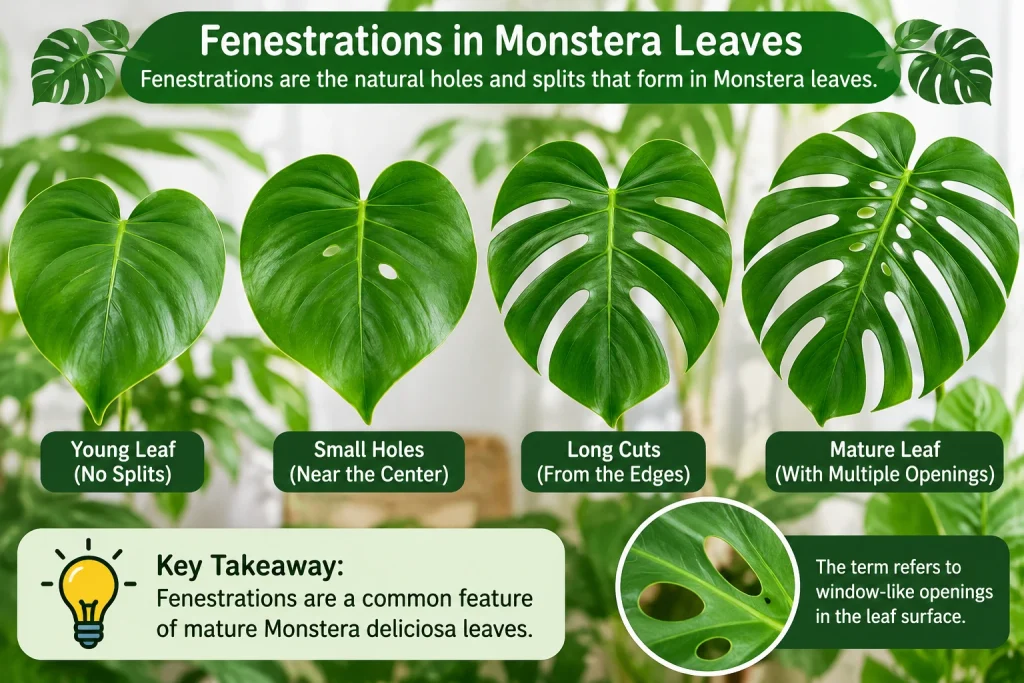
There are two main types of fenestrations:
1. Interior Holes
These are openings that appear inside the leaf blade. They do not connect to the outer edge. They may look round, oval or slightly uneven.
2. Edge Splits
These are cuts that start from the outer edge of the leaf and extend toward the center. They give mature Monstera leaves their divided appearance. Young Monstera deliciosa plants usually have small solid leaves. As the plant matures its new leaves may develop more openings. According to Penn State Extension, young Monstera leaves are mostly uncut, while mature foliage becomes larger and develops holes and cuts. This means that a Monstera with solid leaves may simply be at an early stage of growth.
Why Does My Monstera Have No Splits?
There is no single reason why a Monstera may fail to produce fenestrations. The plant’s age, light, climbing support, watering habits and root health can all affect leaf development.
Here are seven common reasons to check.
1. Your Plant Is Too Young
Young Monstera plants naturally grow small heart shaped leaves without holes. As they mature new leaves may develop natural splits.
2. Not Enough Light
Low light can slow growth and can become the reason of smaller leaves. Place your plant near a bright window with indirect sunlight.
3. No Climbing Support
Monstera is a climbing plant. Adding a moss pole or climbing support can help it grow upward and develop larger leaves and strong stem.
4. Watering Problems
Too much or too little water can affect leaf growth. Check the soil before watering and use a pot with drainage holes. So the extra water will let out.
5. Poor Root Health
Damaged roots can make it difficult for your plant to absorb water and nutrients. Check for soft dark roots if growth becomes slow.
How to Encourage Your Monstera to Grow Split Leaves
If your plant has no splits, you can improve its growing conditions to help it produce stronger new foliage. There is no instant method that makes every Monstera grow holes. However, proper care can help the plant reach the stage where fenestrations may appear.
1 Provide Bright Indirect Light
Place your Monstera near a window where it receives plenty of filtered sunlight. Good light helps the plant produce energy for new growth.
If the room is too dark, consider using a grow light. Avoid placing the leaves in strong afternoon sunlight without first allowing the plant to adjust.
2 Give It a Suitable Climbing Pole
A climbing pole helps keep the stem upright and gives aerial roots a place to attach.
Choose a support that is strong enough for the plant as it grows. Attach the stem gently and check the ties from time to time. They should not cut into the plant.
3 Use Airy Potting Soil
Monstera roots need both moisture and air. A heavy soil mixture can stay wet for too long, which may lead to root problems.
A simple soil mixture can contain potting soil, orchid bark, and perlite.
| Soil Material | Purpose |
|---|---|
| Potting soil | Provides a growing base |
| Orchid bark | Adds larger air spaces |
| Perlite | Helps water drain |
| Coco chips | Adds structure to the mixture |
4 Follow a Suitable Watering Routine
Do not water your plant just because a certain number of days have passed. Check the soil before adding water.
When the upper layer feels dry, water thoroughly and allow the extra water to drain away. During colder months, check the soil more carefully because the plant may use less water.
5 Feed During Active Growth
Monstera plants need nutrients to produce new leaves and stems. You can use a balanced liquid houseplant fertilizer during the active growing season.
Follow the amount written on the product label. Using extra fertilizer will not make leaves split faster. Too much fertilizer can cause salt buildup in the soil and damage the roots.
Reduce feeding when plant growth slows during colder months.
6 Maintain Warm Indoor Conditions
Monstera plants grow well in warm indoor rooms. Cold drafts, sudden temperature changes, and very low temperatures can slow their growth.
Keep the plant away from air conditioners and heaters that blow directly onto the leaves. A stable indoor temperature can help your plant continue growing without unnecessary stress.
7 Clean the Leaves Regularly
Dust can collect on large Monstera leaves. A layer of dust can block some light from reaching the leaf surface.
Use a soft, damp cloth to wipe the leaves gently. Do not rub them too hard. Clean leaves also make it easier to notice pests, brown spots, or other changes.
When Do Monstera Leaves Start Splitting?
There is no exact age or number of months when every Monstera begins producing fenestrations. The first openings usually appear as the plant becomes more mature and starts producing larger leaves. A young plant may produce several solid leaves before its first openings appear.
Here is a general guide to how leaf development can change over time.
| Growth Stage | Common Leaf Appearance |
|---|---|
| Young Plant | Small, solid, heart-shaped leaves |
| Early Growth | Larger leaves without openings |
| First Fenestrations | Small cuts may appear |
| Developing Plant | More holes and edge splits |
| Mature Plant | Larger leaves with several openings |
Do All Monstera Plants Develop Split Leaves?
No. Different Monstera species have different leaf shapes. Before changing your plant care routine, check which species you own.
Here are three commonly grown types:
This is the best known species. Young plants have solid leaves while mature plants can develop large holes and cuts along their edges.
Monstera adansonii
This species is known for its smaller leaves with many interior holes. Its leaves usually have a different shape from the large divided foliage of mature Monstera deliciosa.
This species is grown for its attractive green foliage, which may also have cream or white markings. It does not develop the same typical leaf holes as Monstera deliciosa. A plant may be growing normally even when its leaves do not look like the familiar Swiss cheese pattern.
Monstera Leaves Not Splitting: Problems and Solutions
| What You Notice | Possible Cause | What to Do |
|---|---|---|
| Small leaves without holes | Young plant | Give it time to mature |
| Long stems and small leaves | Low light | Move it near a bright window |
| Plant growing sideways | No climbing support | Add a sturdy pole |
| Yellow leaves and wet soil | Overwatering | Check roots and drainage |
| Dry soil and drooping leaves | Underwatering | Water thoroughly |
| New leaves getting smaller | Poor growing conditions | Check light and root health |
| Slow growth during winter | Seasonal slowdown | Maintain suitable indoor care |
| Brown leaf edges | Dry air or watering problems | Check humidity and soil moisture |
| Weak stems | Low light or lack of support | Improve light and add support |
Mistakes to Avoid When Trying to Get Split Monstera Leaves
Avoiding these mistakes can help keep your Monstera healthy.
1. Cutting Holes Into Solid Leaves
Never cut holes into your Monstera leaves to make them look mature. This damages the leaf and does not create real fenestrations.
2. Giving Too Much Direct Sunlight
Strong sunlight can burn the leaves and cause brown patches. Use bright filtered sunlight instead.
3. Watering Too Frequently
Wet soil can damage the roots. Always check soil moisture before watering.
4. Using Too Much Fertilizer
Extra fertilizer does not guarantee larger leaves or more holes. Use a balanced product according to its label.
5. Removing Healthy Leaves
Solid leaves still collect light and help the plant produce energy. Do not remove healthy foliage just because it has no openings.
6. Changing the Plant’s Location Too Often
Frequent changes in light and temperature can make it harder for your plant to adjust. Choose a suitable location and allow it time to grow.
7. Expecting Fast Results
Monstera leaves take time to develop. Even after improving the growing conditions, you may need to wait for several new leaves before noticing a change.
Final Thoughts
A Monstera without splits is not always an unhealthy plant. Young plants naturally produce solid leaves, and some need more time before their mature foliage appears. Start by checking how much light your plant receives. Then look at its climbing support, soil, watering routine, and root health. Do not cut healthy leaves or use extra fertilizer to force holes to appear. Focus on giving your plant the care it needs to produce strong new growth. With patience and suitable growing conditions, your Monstera may begin producing larger leaves with the natural holes and splits that make Monstera deliciosa so popular as an indoor plant.
Reliable References for Your Article
These university and botanical sources support the plant-care information used in the article:
- Penn State Extension – Monstera as a Houseplant — Young and mature leaves, light requirements, climbing support, and indoor care.
- University of Connecticut – Monstera deliciosa — Fenestrations, aerial roots, soil, and watering.
- University of Minnesota Extension – Monstera deliciosa — Plant growth, roots, and propagation.
- UC Botanical Garden – The Swiss Cheese Plant — Botanical information about how Monstera leaf openings form.
- University of Wisconsin–Madison – Swiss-Cheese Plant — Mature foliage, climbing growth, and indoor growing conditions.
FAQs
Why does my Monstera have no splits?
Your Monstera may be too young to grow split leaves. Low light, poor growing conditions, and a lack of climbing support can also delay leaf development.
At what age do Monstera leaves start splitting?
Monstera leaves may begin developing splits as the plant matures. The timing depends on the species, light, growing conditions, and plant health.
Will my Monstera leaves develop holes later?
No. Once a leaf has fully opened, it will not develop new holes. Fenestrations usually appear as new leaves grow.
Does a Monstera need a moss pole to grow split leaves?
A moss pole is not required, but climbing support can help the plant grow upright and develop larger leaves as it matures.