Tools and Instruments for a Monstera Plant
A Monstera plant is small in size so that’s why it does not need a room full of gardening equipment. A few simple tools can also make watering, pruning, cleaning, repotting and plant support much easier. Some tools are useful for almost every Monstera owner. Others are optional and may only help when the plant becomes large or needs special care.
1. Tools for Cutting and Pruning
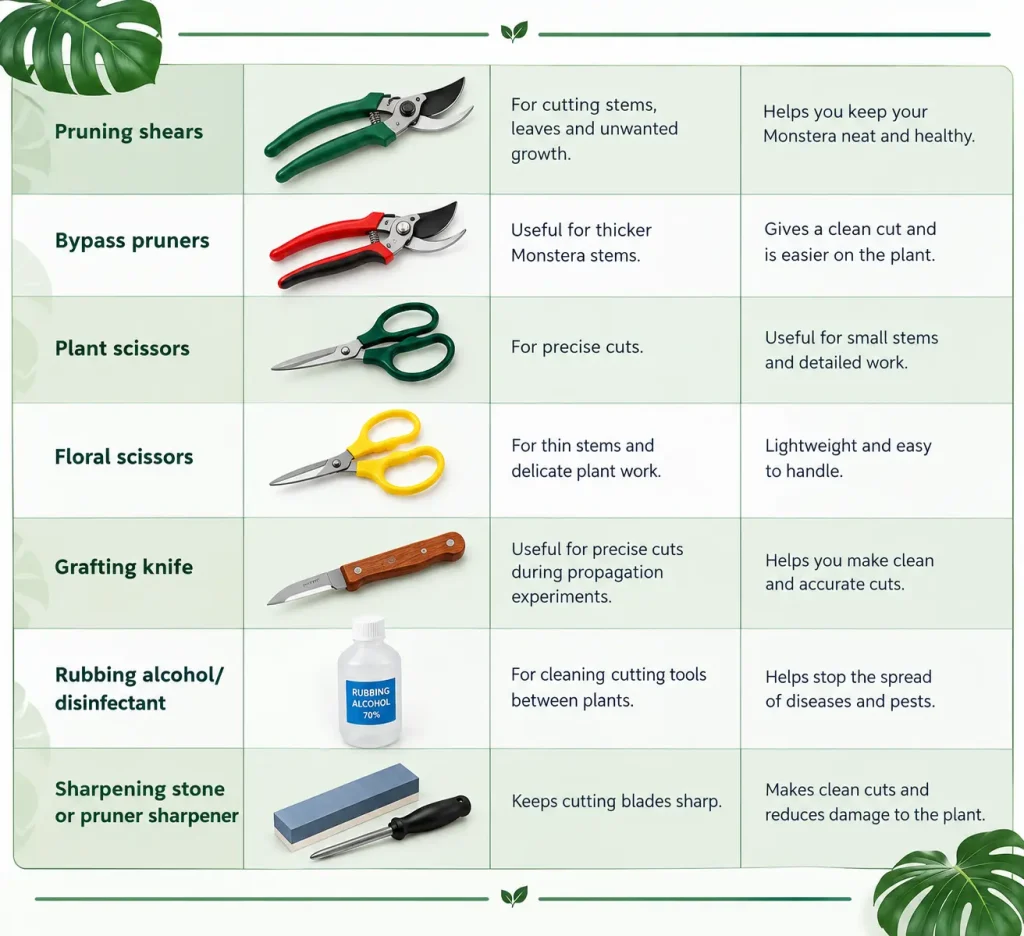
Tools for Cutting and Pruning are one of the most useful tools for a Monstera. They are used to remove yellow, damaged or dead leaves. They can also be used to cut stems when you need to prune the plant or take a stem cutting for propagation.
2. Tools for Watering
A watering can gives you better control than pouring water straight from a large container. Choose one with a narrow spout if possible. It can help you direct water toward the soil without making a mess around the plant. When watering a Monstera apply water slowly and evenly across the soil. If the pot has drainage holes extra water should be able to leave through the bottom. Do not water your Monstera simply because a certain number of days have passed. Check the soil first.
Watering can — gives better control when watering.
Long-spout watering can — useful for reaching soil beneath large leaves.
Measuring jug — helps measure water or plant treatments.
Watering wand — useful for larger plant collections.
Self-watering system — can supply water over time when properly set up.
Watering globe — provides slow water release, though it is not needed for every Monstera.
Drainage tray — catches water leaving the pot.
Syringe or dosing bottle — useful for small amounts of water or measured treatments.
Tools for Water Quality
Water filter — filters certain substances from water.
Water testing kit — checks selected water properties.
TDS meter — checks dissolved solids.
EC meter — checks electrical conductivity.
Water thermometer — checks water temperature when needed.
3.Propagation and Cutting Support
Propagation means making a new plant from a previous one plant. By taking a healthy stem from previous plant. You also have to support the plant with moss pole or other supporting thing when the plant start producing new leaves. The required tools for propagation and cutting are:
| Tool | Main Use |
|---|---|
| Sterile scalpel | Allows very precise cuts during propagation work. |
| Propagation clips | Keep cuttings positioned correctly while they develop roots. |
| Rooting container | Provides a suitable place for roots to develop. |
| Perlite propagation container | Used for propagation methods that use perlite as the rooting medium. |
| Sphagnum moss container | Used for propagation with moist sphagnum moss. |
| LECA container | Used for semi-hydroponic growing and some propagation methods. |
| Water-level indicator | Shows the water level in some semi-hydroponic setups. |
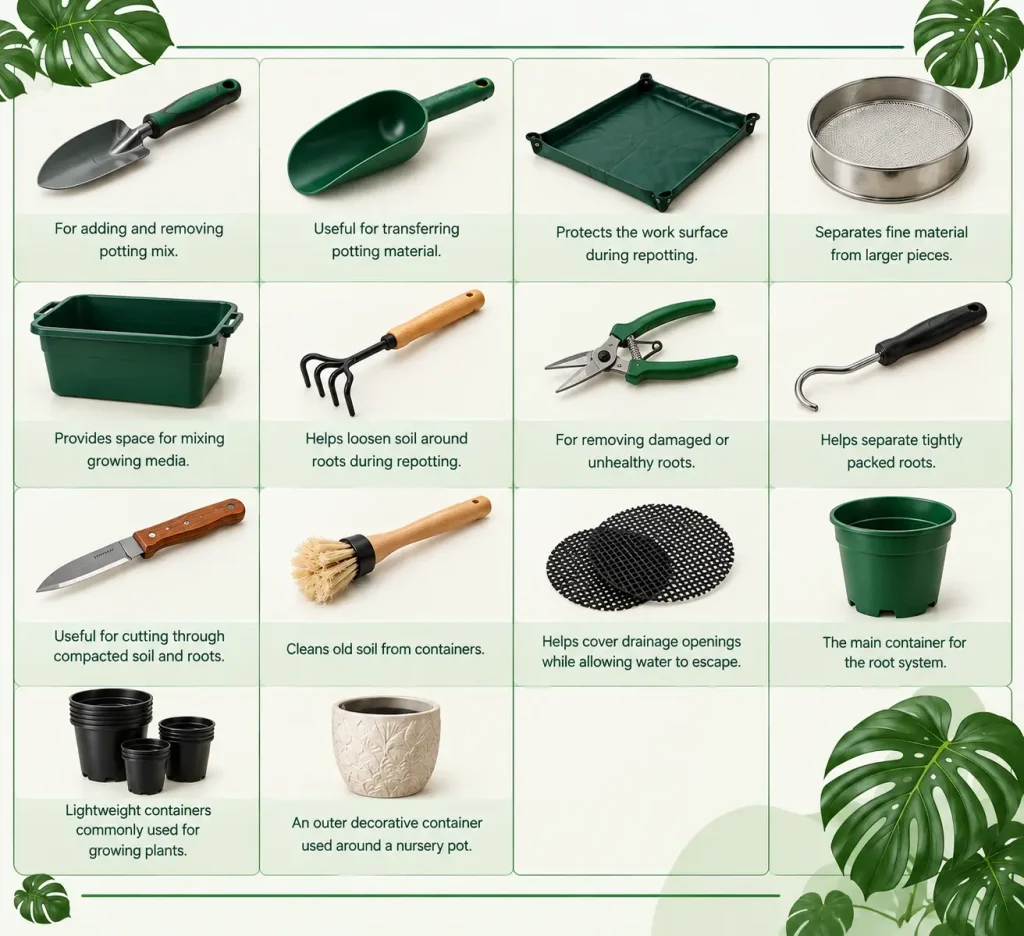
4.Tools for Soil and Potting
5. Soil checking
You have to check the soil before you can plant a monstera plant. Is that soil is best for a plant.
For checking the soil quality you require these tools:
Soil moisture meter — checks moisture levels in the growing medium.
Digital moisture meter — provides a digital reading.
Soil pH meter — checks the acidity or alkalinity of the growing medium.
Digital pH meter — provides a numerical pH reading.
Soil pH test kit — another method for checking pH.
EC meter — measures electrical conductivity and can help assess dissolved salts in the growing medium.
TDS meter — measures total dissolved solids in water.
Soil thermometer — measures growing medium temperature.
6.Humidity and Air Tools
Humidifier — increases moisture in the surrounding air.
Cool-mist humidifier — commonly used indoors.
Fan — improves air movement around plants.
Small circulation fan — useful in indoor growing areas.
Ventilation fan — helps exchange indoor air.
Air purifier — may be used in indoor plant rooms, although it is not a Monstera-specific tool.
7.Pest and Disease Treatment Tools
| Tool | Use |
|---|---|
| Pressure sprayer | Applies suitable plant treatments over larger plants. |
| Fine-mist sprayer | Distributes liquid in small droplets. |
| Measuring syringe | Measures small quantities of plant products. |
| Measuring spoons | Useful for products that require measured amounts. |
| Protective gloves | Protect hands while handling certain plant treatments. |
| Protective eyewear | Useful when working with products that require eye protection. |
8.Measuring and Record-Keeping Tools
When your monstera start growth or made changes you have to notice or record those thing’s. For measuring and record keeping tools you require:
Ruler — measures leaf size, stem length and growth.
Measuring tape — useful for larger plants.
Digital scale — can help monitor pot weight when learning when a plant has dried.
Kitchen scale — may work for small pots.
Plant journal — records watering, repotting, propagation and growth.
Plant tags — identify plants and cuttings.
Permanent marker — writes information on plant labels.
Plant camera or phone camera — records changes in growth over time.
9. Leaf Cleaning tools
Monstera leaves can collect dust especially when the plant is kept indoors. A soft, clean damp cloth can be used to gently wipe large leaves. Support the leaf with one hand while cleaning it with the other. Be gentle around new leaves and avoid rubbing hard. Clean leaves can also make it easier to notice pests, spots, and other changes. Plain water is usually enough for routine dust removal. Household cleaners, oils or other products should not be put on the leaves unless they are made for plant use and you know how to use them safely.
Some of other tools used for leaf cleaning are:
Soft microfiber cloth — removes dust from leaves.
Soft sponge — can be used carefully on broad leaves.
Plant cleaning brush — useful for gentle dust removal.
Hand air blower — removes loose dust without rubbing the leaf.
Spray bottle — useful for certain plant-care tasks and treatments.
10. Plant Label
A small plant label is useful when you have several Monstera’s.
You can write:
* Plant name
* Date of propagation
* Date of repotting
* Watering notes
* Other useful records
Labels become especially helpful when you have several plants that look similar.
11. Gloves
Gloves are not required for every Monstera task but they can make repotting and pruning cleaner. They can protect your hands from soil and plant sap. Wash your hands after handling plant material. Keep gardening gloves clean, particularly if you work with more than one plant.
12. Cleaning and Work-Safety Tools
| Tool | Use |
|---|---|
| Gardening gloves | Protect hands during plant work. |
| Apron | Keeps clothing cleaner during repotting. |
| Work tray | Keeps small tools together. |
| Storage box | Stores plant-care equipment. |
| Cleaning brush | Cleans pots and tools. |
| Paper towels | Useful for wiping tools and work surfaces. |
| Disinfectant container | Provides a place to clean reusable tools. |
13. Tools for Fertilizer Use
Fertilizer measuring spoon — measures dry fertilizer.
Measuring cup — measures liquid products.
Mixing container — mixes fertilizer with water.
Digital scale — provides more precise measurements for products that call for weight.
Fertilizer injector — useful mainly in larger growing systems.
14.Pest Inspection Tools
Magnifying glass — helps inspect small pests.
Hand lens — provides stronger close-up viewing.
Digital microscope — allows close inspection of tiny pests and leaf damage.
Sticky traps — can help monitor flying insects.
Small inspection flashlight — helps check leaf undersides and stems.
Cotton swabs — useful for carefully treating small pest-affected areas.
Basic Monstera Tool Kit
| Tool or Supply | Main Use | Need Level |
|---|---|---|
| Pruning shears | Cutting stems and damaged growth | Basic |
| Watering can | Controlled watering | Basic |
| Pot with drainage holes | Growing the plant | Basic |
| Suitable potting mix | Root growth | Basic |
| Plant support | Supporting climbing growth | Useful |
| Soft plant ties | Attaching the plant to support | Useful |
| Hand trowel | Repotting | Useful |
| Plant tray | Catching excess water | Useful |
| Leaf cleaning cloth | Removing dust | Useful |
| Moisture meter | Checking soil moisture | Optional |
| Spray bottle | Light spraying and treatments | Optional |
| Magnifying glass | Checking leaves and pests | Optional |
| pH meter | Checking growing medium acidity | Optional |
Tools You Do Not Need to Buy Immediately
New Monstera owners often feel that they need every gardening tool available.
You usually do not.
For a small indoor plant start with a clean cutting tool, a suitable pot with drainage holes, good growing material, a watering container and a support when the plant needs one.
A moisture meter, pH meter, special leaf products and other gadgets can come later if you find that they solve a real problem.
The plant itself matters more than having a large collection of equipment.
How to Keep Monstera Tools Clean
Clean tools are useful when working with plants.
After pruning:
1. Remove plant pieces from the blades.
2. Wipe away soil or plant residue.
3. Disinfect the cutting surfaces with an appropriate disinfectant.
4. Allow the tool to dry.
5. Store it somewhere clean and dry.
Do the same when moving between plants, particularly when one plant shows signs of disease or pest damage.
Do not put dirty pruning tools away while they are still wet. Moisture can lead to rust on some metal tools.
Final Thoughts
Taking care of a Monstera does not require a large collection of gardening equipment. A few useful tools can make everyday tasks easier and help you work more carefully. Start with the basics: a suitable pot, good growing material, a watering can, clean pruning shears and a support when needed. Add items such as a moisture meter or magnifying glass only when they are useful for your plant.
Good plant care comes from paying attention to the plant, the soil, water, light, roots and new growth. The tools are there to help you do those tasks properly not to replace careful observation.
FAQs
What tools do I need to care for a Monstera plant?
The main tools include pruning shears, a watering can, a pot with drainage holes, suitable potting mix, plant support, and soft plant ties. Other tools can be added when you need them.
Do I need pruning shears for a Monstera?
Pruning shears are useful for cutting damaged leaves, unwanted stems, and suitable sections for propagation. Keep the blades clean and sharp before making cuts.
What tool is best for cutting thick Monstera stems?
Bypass pruners or strong pruning shears can be useful for thicker stems. The tool should be sharp enough to make a clean cut without crushing the stem.
Is a moisture meter necessary for Monstera care?
A moisture meter is optional. It can help you check moisture below the surface, but you can also check the soil by touch and observe how quickly the pot dries.
What tool can I use to support a climbing Monstera?
A moss pole, coir pole, stake or trellis can provide support. Soft plant ties or plant clips can help keep the stems close to the support.