๐ŸŒฟMonstera Plant vs Pothos Plant

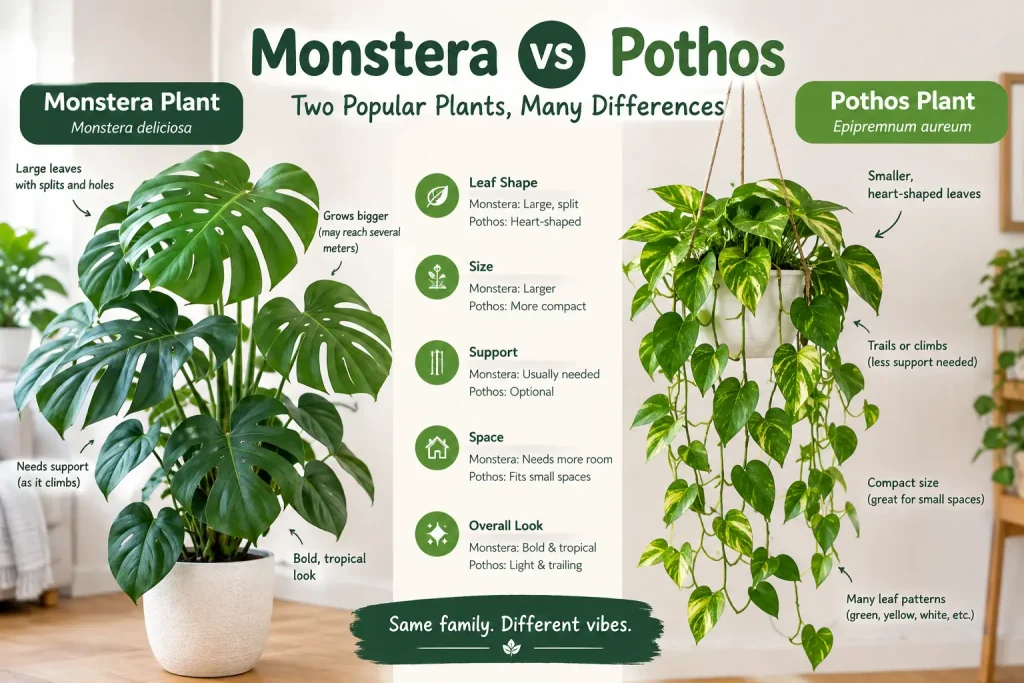
Both of Monstera and Pothos are two most popular houseplants. Both can climb, both grow well indoors and both belong to the Araceae family. But they are not the same plant. The differences can be seen in their leaves๐Ÿƒ, growth pattern, mature size, support needs and care requirements.
The name Pothos can cause confusion. The plant commonly sold as Pothos is usually Epipremnum aureum while the true genus Pothos is a different group of plants. Kew lists Epipremnum aureum as an accepted species in the Araceae family and notes that it is a tropical climber.

Monstera vs Pothos at a Glance

๐ŸŒฑ Feature๐ŸŒฟ Monstera๐Ÿƒ Pothos
๐Ÿ”ฌ Common botanical nameMonstera deliciosaEpipremnum aureum
๐ŸŒฟ Plant familyAraceaeAraceae
๐Ÿง— Natural growthClimbingClimbing
๐Ÿƒ Leaf sizeLargeSmall to medium
๐Ÿ”Ž Mature leaf shapeLarge, split or perforatedHeart-shaped, usually whole
๐Ÿ•ณ๏ธ Leaf holesCommon on mature Monstera deliciosaNot typical
๐Ÿ  Growth spaceNeeds more roomFits smaller spaces
๐Ÿชต SupportOften benefits from a poleCan trail or climb
๐ŸŒฑ Indoor growth styleLarge climbing plantTrailing or climbing vine
โญ Best known featureLarge leaves with holes and splitsHeart-shaped leaves with trailing stems

๐ŸŒฑ1. Monstera and Pothos Are Different Plants

The first thing to know is that Monstera and Pothos are different genera.

Monstera belongs to the genus Monstera. The genus contains many accepted species and Kew currently lists 73 accepted species in the genus. The plant commonly called Pothos is generally Epipremnum aureum. Kew lists Epipremnum aureum as an accepted species in the genus Epipremnum. There is also a separate botanical genus called Potho. Kew lists Pothos as its own accepted genus within the Araceae family. This means the common houseplant called Pothos and the botanical genus Pothos are not always referring to the same thing.๐ŸŒฟ

๐Ÿƒ2. Their Leaves Look Very Different

The leaves are one of the easiest ways to tell these plants apart. A mature Monstera deliciosa develops very large leaves. The RHS lists leaves that can reach around 90 cm long, with leaves that may have deep splits and holes.

๐Ÿ‘€๐ŸŒฟPothos has much smaller leaves. Its leaves are usually heart-shaped and remain mostly whole rather than developing the large holes and splits seen on mature Monstera deliciosa. This makes the two plants easy to separate once you know what to look for.

๐Ÿ•ณ๏ธ3. Monstera Leaves Develop Holes and Splits

One of the most famous features of Monstera is its mature foliage.๐Ÿƒย 

Young Monstera leaves ๐ŸŒฟcan look quite different from mature leaves. A young leaf may have a simple heart shape with little or no fenestration. As the plant matures under suitable growing conditions the leaves can develop holes and splits. The RHS notes that Monstera plants usually begin producing their characteristic holey leaves after they have grown for a few years. Pothos does not normally develop this type of leaf fenestration.๐Ÿƒ.

๐Ÿ“ 4. Monstera Gets Much Larger

Size is another major difference. A mature Monstera deliciosa can become a very large indoor plant. The RHS gives a possible height of 4โ€“8 metres and a spread of 1.5โ€“2.5 metres under suitable growing conditions. Of course, an indoor Monstera may stay much smaller because its size depends on the pot, light, support, pruningโœ‚๏ธ, growing conditions and available space. Pothos is generally easier to fit into a small room because it can be grown as a trailing plant. Its stems can hang from a shelf, basket, or plant stand instead of taking up the floor space that a large Monstera may need.

๐Ÿง—5. Their Growth Habits Are Similar but Not the Same

Both plants are climbers๐ŸŒฟ๐Ÿง—.ย 

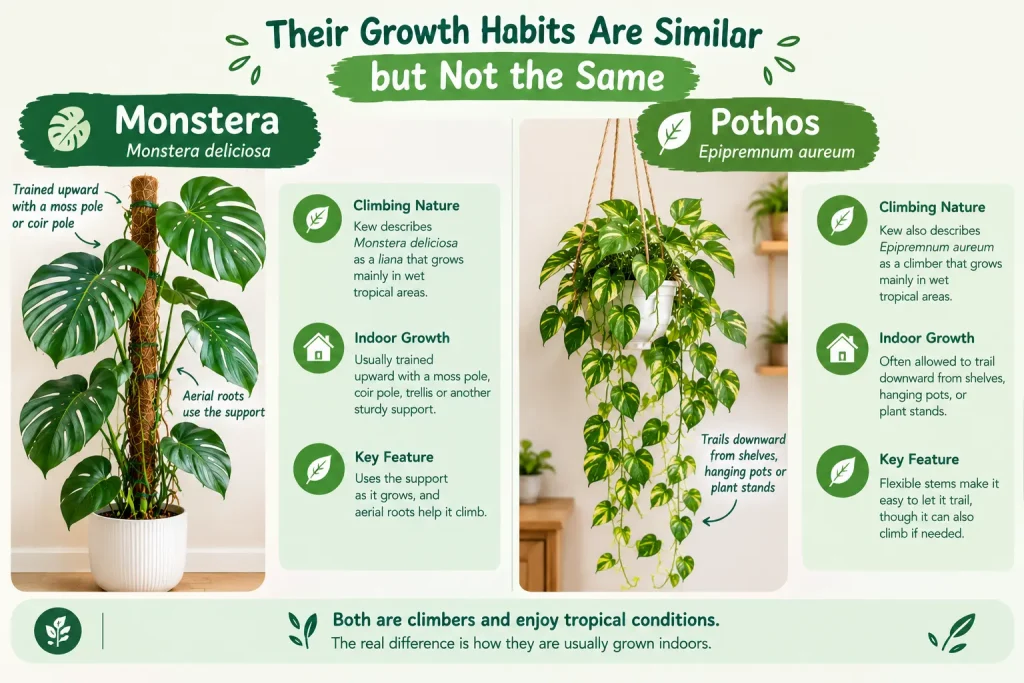
Kew describes Monstera deliciosa as a liana that grows mainly in wet tropical areas. Kew also describes Epipremnum aureum as a climber that grows mainly in wet tropical areas. The big difference is how they are usually grown indoors. Monstera is often trained upward with a moss pole, coir pole, trellis or another sturdy support. As the plant grows, its stems and aerial roots can use the support.

Pothos can also climb, but many people allow it to trail downward from shelves, hanging pots or plant stands๐Ÿชดโฌ‡๏ธ.

leave difference

๐Ÿ 6. Monstera Usually Needs More Space

A small Monstera can fit comfortably on a table but this can change as the plant grows. The leaves become larger, the stems become longer and the plant may need support. A mature Monstera can take up a good amount of vertical and horizontal space. Pothos is easier to place in small areas. Its trailing growth makes it useful for shelves, hanging baskets, desks and smaller rooms. This does not mean Pothos cannot become large. Long stems can grow several feet when conditions are good but the plant is generally easier to manage in a limited indoor space.

โ˜€๏ธ7.Their Light Needs Are Fairly Similar

Both Monstera and Pothos can grow indoors with suitable light.๐ŸŒž๐ŸŒฟ Monstera generally does well in bright, indirect light. The RHS recommends indirect light for Swiss cheese plants and notes that they are tropical plants that prefer warm and humid conditions. Pothos is also known for adapting to indoor conditions but very low light can reduce growth and may affect the appearance of plants with strong leaf patterns.

๐Ÿ’ง8. Watering Is Important for Both Plants

Neither plant should sit in water for long periods.
For Monstera the RHS advises avoiding overwatering and leaving the pot standing in water because this can lead to root problems.
Pothos also does better when its growing medium is allowed to dry somewhat between waterings rather than staying constantly wet.

The exact watering schedule depends on factors such as:

* ๐Ÿชด Pot size
* ๐ŸŒฑ Type of potting mix
* ๐ŸŒก๏ธ Temperature
* ๐Ÿ’ง Humidity
* โ˜€๏ธ Amount of light
* ๐Ÿ“… Season
* ๐ŸŒฟ Root size

๐Ÿชต 9. Monstera Often Benefits From a Moss Pole

A support can make a big difference to a climbing Monstera.
In nature Monstera grows as a climbing plant. Indoors a moss pole or similar support can give the stems a place to grow upward.
A support can also help keep a large plant from spreading across the floor.
Pothos can use a support too but it does not always need one. Many indoor growers prefer to let Pothos trail from a hanging pot or shelf.

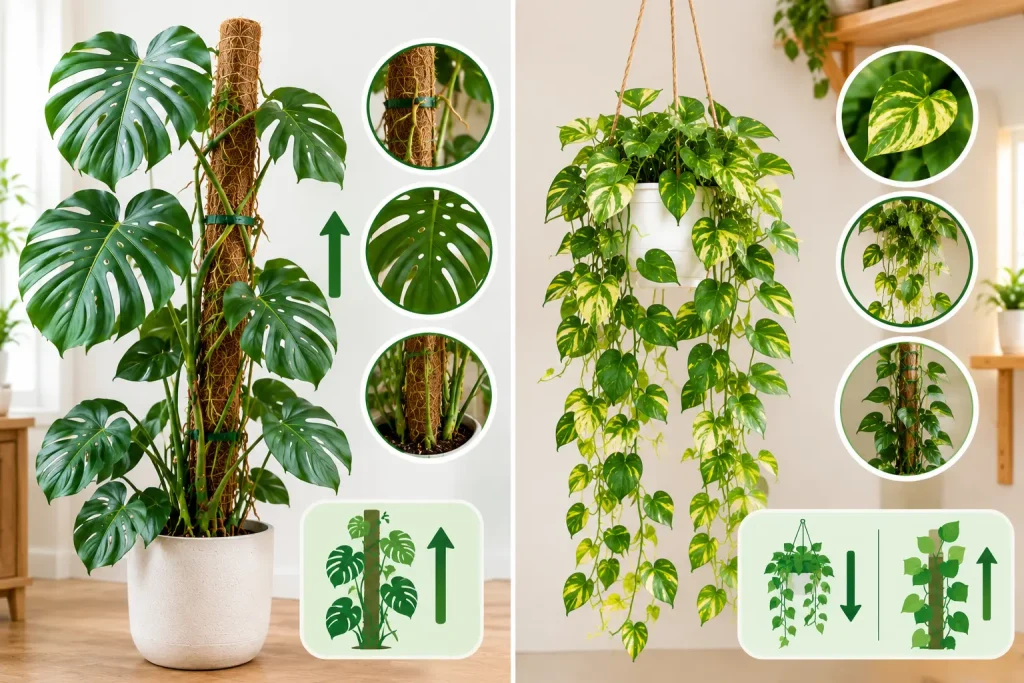
This gives you two different ways to use the plants:

Monstera: often grown upward.โฌ†๏ธ๐ŸŒฑ

Pothos: often grown downward or upward.

๐Ÿƒ10. Which Plant Has Larger Leaves?

Monstera has much larger leaves.๐Ÿƒ๐Ÿ“ This is one of the easiest differences to see. A mature Monstera deliciosa can produce leaves approaching 90 cm in length according to the RHS.
Pothos leaves are much smaller in comparison. If your main goal is a plant with large tropical foliage, Monstera is the obvious choice. If you prefer smaller heart-shaped leaves on long trailing stems Pothos fits that style better.

๐Ÿ’ง 14. Monstera vs Pothos: Care Differences

๐ŸŒฑ Care Need ๐ŸŒฟ Monstera ๐Ÿƒ Pothos
โ˜€๏ธ LightBright, indirect lightBright to moderate indirect light
๐Ÿ’ง WaterWater when the growing mix has dried somewhatWater when the growing mix has dried somewhat
๐Ÿ’ฆ HumidityLikes higher humidityCan handle normal indoor humidity
๐Ÿชต SupportOften useful as the plant gets largerOptional
๐Ÿ  SpaceNeeds more room as it maturesWorks well in smaller spaces
๐ŸŒฟ GrowthLarge climbing plantTrailing or climbing vine
๐Ÿƒ LeavesLarge, often split or perforatedSmaller, heart-shaped
โœ‚๏ธ PruningUseful for controlling sizeUseful for controlling long stems

Experts Advice

Before choosing one think about your available space, the amount of light in the room and the type of plant you want to grow.

Choose Monstera if you want large tropical leaves and have enough room for the plant to grow upward.

Choose Pothos if you want a smaller plant that can trail from a shelf or hanging pot.

Both can add plenty of greenery to an indoor space when their basic growing needs are met.

FAQs

1. ๐ŸŒฑ Are Monstera and Pothos the same plant?

No. Monstera and Pothos are different plants, although both belong to the Araceae family. The houseplant commonly called Pothos is usually Epipremnum aureumย ย while Monstera deliciosa belongs to the genus Monstera.

2. ๐Ÿƒ What is the main difference between Monstera and Pothos?

The biggest difference is their leaves and growth habit. Monstera develops much larger leaves that can form holes and splits as the plant matures. Pothos has smaller, heart shaped leaves that usually stay whole.

3. ๐ŸŒฟ Which plant gets bigger, Monstera or Pothos?

Monstera can become much larger, especially when it has enough space and support. Pothos can also grow long but its leaves and overall structure are usually smaller.

4. ๐Ÿ•ณ๏ธ Does Pothos have holes like Monstera?

Usually, no. Mature Monstera deliciosa leaves can develop natural holes and splits while Pothos normally keeps its leaves whole.

5. ๐Ÿชต Does Monstera need a moss pole?

A moss pole can be useful for a climbing Monstera. It gives the plant support as it grows upward and can help keep a large plant from spreading across the floor.

6. ๐ŸŒฑ Can Pothos climb like Monstera?

Yes. Pothos can climb when given suitable support, but many people grow it as a trailing plant from hanging pots, shelves, or plant stands.

7. โ˜€๏ธ Do Monstera and Pothos need the same light?

Their light needs are fairly similar. Both can grow indoors with suitable light, but bright, indirect light is a good choice for Monstera. Pothos can also grow in moderate indoor light.

8. ๐Ÿ’ง Do Monstera and Pothos need the same amount of water?

Not always. Both plants should not be left sitting in water, and watering should depend on the condition of the growing mix. Factors such as light, temperature, pot size, and humidity can affect how often each plant needs water.

9. ๐Ÿ  Which is better for a small room, Monstera or Pothos?

Pothos can be easier to manage in a small room because its trailing stems can grow from shelves or hanging pots. Monstera usually needs more room as its leaves and stems become larger.

10. ๐ŸŒฟ Can Monstera and Pothos grow in the same room?

Yes. Both can grow in the same room when their basic needs are met. Give each plant suitable light, drainage, watering and enough space for its growth.

Scroll to Top