
Botanical Classification of Monstera Plant
People mostly know it due to its large green leaves having natural holes on them and its eye catching appearance While many people grow Monstera for its beauty and not everyone knows where this plant belongs in the plant world or kingdom.Learn about botanical classification of Monstera plant will helps you to understand its family, close relatives and the traits that make this plant different from other well known plants. It also helps many gardeners choose the right care because plants from the same family often have similar growing and other needs.
What is Botanical Classification?
A system that groups plants based on their shared features and their natural relationships is called Botanical classification. Scientists use this system to give every plant a scientific good name and place it into different groups of related plants.
Each group becomes specific starting with the largest group and ending with the exact species.
For a Monstera plant system shows that it is a flowering plant in the arum family also known as Araceae. Modern plant databases including the Royal Botanic Gardens and Kew accept this classification and also said that monstera plant mostly flower outdoor its a rare one who flower indoor.
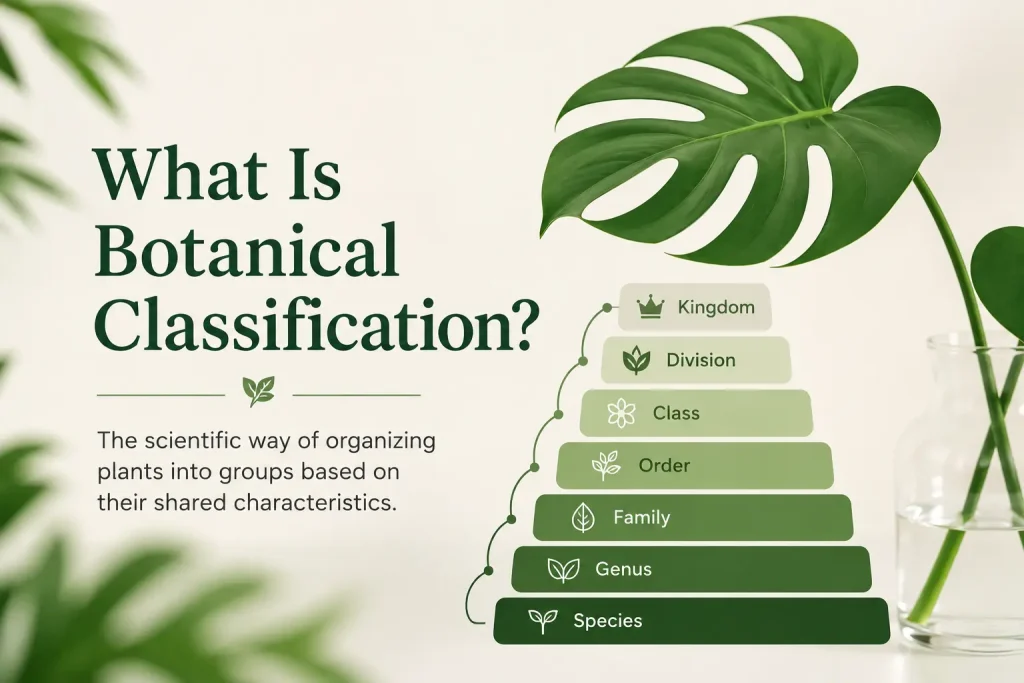
Botanical Classification of Monstera plant
This table shows the accepted botanical classification of Monstera plant genus.
| Rank | Classification |
|---|---|
| Kingdom | Plantae |
| Division | Magnoliophyta |
| Class | Liliopsida |
| Order | Alismatales |
| Family | Araceae |
| Genus | Monstera |
| Species | Monstera deliciosa |
This classification is accepted by all main botanical databases such as Plants of the World Online from the Royal Botanic Gardens and Kew.
Understanding Each Classification
Kingdom: Plantae
Monstera plant belongs to the kingdom Plantae which includes all other related green plants looks like a monstera plant. Plants in this kingdom don’t need food from other providers they make their own food through photosynthesis. Photosynthesis is process of making food by using sunlight, water and carbon dioxide.
Division: Streptophyta
This division includes land plants and their closest green algae relatives. All members have strong cell walls and other features that help them grow very well on land.
Class: Equisetopsida
This class includes many land plants such as flowering plants. It group all the plants that share important structural traits.
Subclass: Magnoliidae
Monstera belongs to a large group of flowering plants that includes monocots and they are known as a to Magnoliidae.
Order: Alismatales
The order of Alismatales includes some families of flowering plants. Many members of this order grow in tropical forests or wet places and provide a good look.
Family: Araceae
The Araceae family is also called the arum family.
Many popular indoor plants belong to this family which are:
* Philodendron
* Anthurium
* Peace Lily
* Pothos
* Monstera
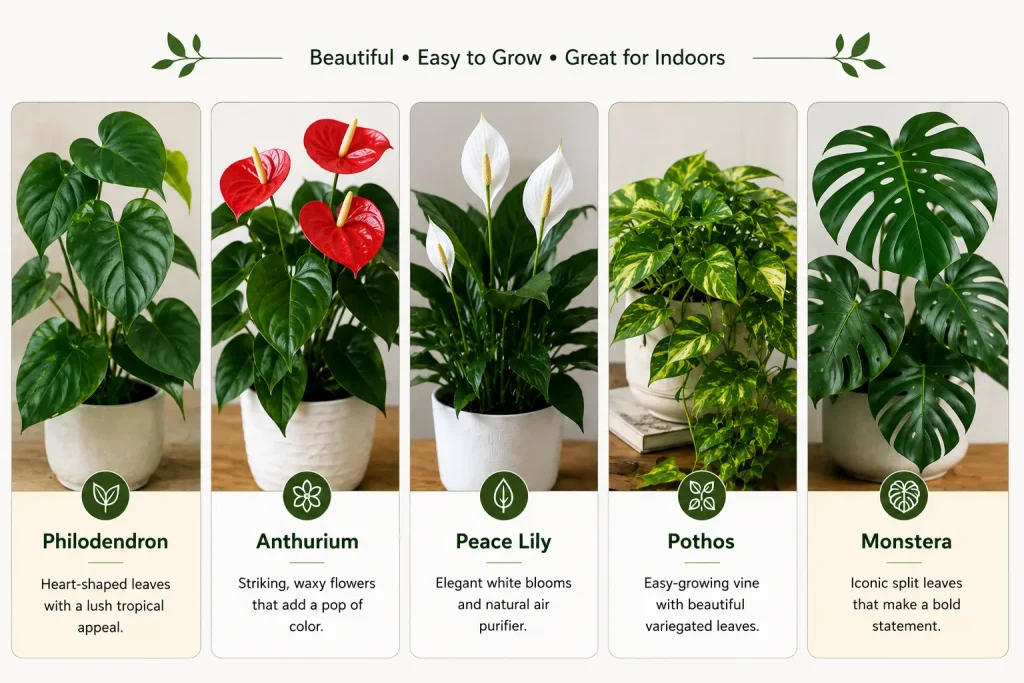
Plants in this family usually have:
* Thick dark or light green leaves
* Having a flower spike called a spadix
* Leaf like cover called a spathe
* Strong aerial roots in some climbing species
These shared features help botanists to place Monstera plant in the Araceae family.
Genus: Monstera
The genus is the group that brings together closely related species.
Scientist mostly recognize that more than 70 accepted Monstera species include new species continue to be studied as tropical forests receive more botanical attention. Most species belongs to Mexico, Central America and South America.
Some well known species include:
* Monstera deliciosa
* Monstera adansoni
* Monstera obliqua
* Monstera acuminata
* Monstera dubia
Each species has its own different ability for other type such as leaf shape, growth pattern and native habitat.
Species: Monstera deliciosa
The most famous houseplant is Monstera deliciosa. It is mostly loved as an indoor plant.
It was first named in 1849 and is native to southern Mexico and Guatemala. In the wild and it grows as a climbing vine in warm. It is mostly planted as an indoor plant and use a moss pole for its climbing.
Its scientific name has two parts:
1. Monstera as The genus
2.Deliciosa as The species
This two part naming system is called binomial nomenclature.
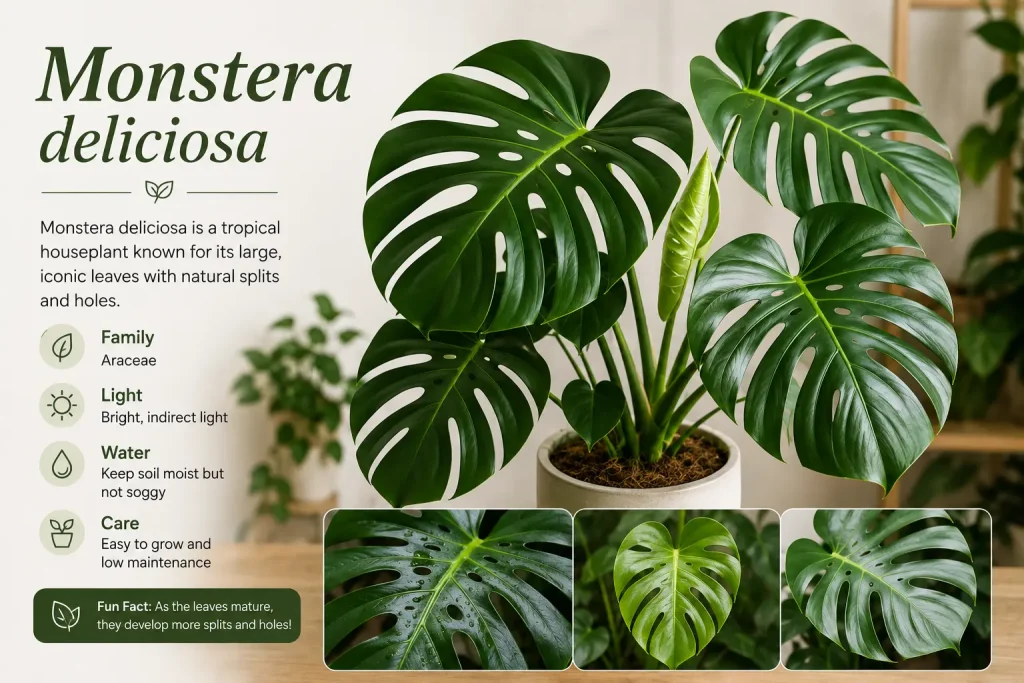
Why is it called Monstera?
The word or name Monstera cames from a Latin word that refers to something rare or unusual. Botanists said that the name was chosen due to the plant’s large green leaves with natural holes and it’s amazing size.
These openings are called fenestrations. They are one of the easiest ways to recognize the Monstera species.
Main Features That Help Scientists Identify Monstera
Scientists look at all plant features before placing into the Monstera genus.
Some of the main traits include:
* Evergreen climbing growth
* Thick aerial roots
* Large heart shaped leaves
* Natural holes or deep leaf splits in mature plants
* Flowers growing on a spadix
* A surrounding spathe
* Berry like fruits in mature plants
These traits separate Monstera plant from other climbing plants.
Is Monstera plant a Philodendron?
No. Monstera plant is not a Philodendron.Mostly people has a confusion of Monstera with Philodendron because both of they belong to the same family and looks little same.They are close relatives but they belong to different genera.
| Monstera | Philodendron |
|---|---|
| Genus: Monstera | Genus: Philodendron |
| Many mature leaves develop natural holes | Most species have solid leaves |
| Fewer accepted species | Hundreds of accepted species |
Although they share several traits but botanists classify them as separate plant groups.
Native Habitat of Monstera
Monstera naturally grows in rainforests. Its native range stretches from southern Mexico through Central America and into parts of South America. Many species climb tall trees while other keeping their roots in the soil. Botanists call this growth habit a hemiepiphyte.Warm temperatures, high humidity and indirect sunlight help these plants grow well in nature.
Why Botanical Classification Matters
Knowing the botanical classification of Monstera gives plant lovers useful information and help them in solving monstera many problems and made easy to care and maintain.
It helps you:
* Learn how the plant related to other species.
* Understand its natural growing habits.
* Identify different Monstera species.
* Read plant labels with confidence.
* Use trusted scientific names instead of confusing common names.
Final Thoughts
Monstera plant belong to a famous group of flowering plants called the Araceae family. Its scientific classification places it among climbing plants but it’s mostly types start climbing when the that share thick aerial roots, a spadix flower and broad green leaves. Among all species of monstera plant Monstera deliciosa remains the best known choice for homes around the world and it is mostly common as an indoor plant.Knowing this classification helps gardeners, students, beginner’s and plant lovers to understand where Monstera fits in the plant kingdom and why it grows the way it does. It also makes it easier to identify all the related species and use the correct scientific names when reading plant guides or buying a new plant.
FAQs
What family does Monstera belong to?
Monstera belongs to the *Araceae* family, commonly called the arum family.
What is the scientific name of the Swiss Cheese Plant?
The Swiss Cheese Plant is *Monstera deliciosa*.
Is Monstera a flowering plant?
Yes. Monstera is a flowering plant. Its flowers grow on a spadix that is covered by a spathe, which is typical for members of the Araceae family.
How many Monstera species are there?
Plants of the World Online currently accepts more than 70 Monstera species, and botanical work continues as new species are studied.